Crown & Influence: Margaret of Anjou - The Warrior Queen Who Wouldn't Surrender

Henry VI's French queen transformed from peace bride to military commander, fighting for thirty years to save her husband's crown and her son's inheritance
She arrived in England as a fifteen-year-old peace offering, a bride meant to end decades of warfare between England and France. She died in exile and poverty thirty-seven years later, having led armies, orchestrated plots, and fought with ferocious determination through one of England's bloodiest conflicts. Margaret of Anjou, Queen of England and wife of the tragic Henry VI, became one of the most formidable political and military figures of the Wars of the Roses—a woman whose refusal to accept defeat prolonged the conflict for years and whose fierce maternal devotion made her both admired and reviled. In an age when Joan of Arc had shown that French women could be warriors, Margaret proved they could be generals and politicians too.
The Peace That Never Was
Margaret was born in 1430 in Lorraine, daughter of René of Anjou, a cultured prince known more for his poetry and artistic patronage than his political success. She grew up at a sophisticated French court, educated in literature, music, and the arts. She was also a contemporary of Joan of Arc—the Maid of Orléans was burned at the stake when Margaret was just one year old, but Joan's legend of French women taking up arms to save their kingdom would haunt Margaret's own story.
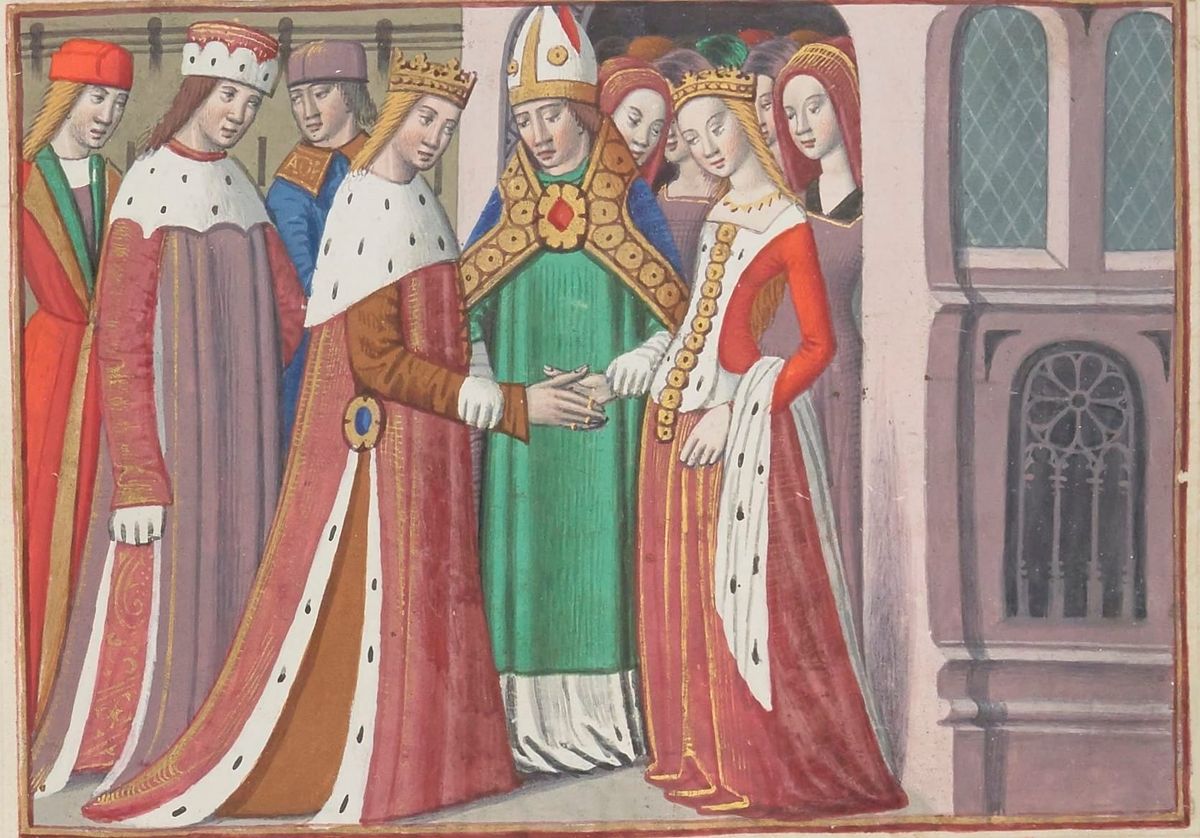
In 1445, Margaret was chosen as bride for Henry VI of England as part of the Treaty of Tours, meant to bring peace to the Hundred Years' War. She was fifteen; Henry was twenty-three. It seemed a promising match—Henry was pious and gentle, and Margaret was intelligent and strong-willed. But the marriage would prove catastrophic for both.
Margaret arrived in England to a mixed reception. She brought no dowry—instead, Henry had secretly agreed to surrender Maine and Anjou to France, territories the English had fought for decades to control. When this became public knowledge, it sparked outrage. Margaret was blamed for the humiliating concession, though she had nothing to do with negotiating the treaty. From her first days in England, she was viewed with suspicion as a French interloper.
The Mad King's Guardian
For the first eight years of their marriage, Margaret tried to fulfill the traditional role of a medieval queen consort—patronizing the arts, mediating disputes, and attempting to produce an heir. But increasingly, she discovered that her husband was incapable of effective rule. Henry VI was pious to the point of otherworldliness, prone to fits of catatonia, and utterly lacking in the ruthlessness medieval kingship required.
In 1453, two disasters struck simultaneously. First, England's position in France collapsed entirely with the loss of Bordeaux, marking the effective end of the Hundred Years' War in humiliating defeat. Second, Henry VI suffered a complete mental breakdown, falling into a catatonic state where he recognized no one, spoke to no one, and was incapable of any action. He remained in this state for seventeen months.
During Henry's madness, Margaret gave birth to their only child, Prince Edward, in October 1453. The king was shown his infant son but gave no sign of recognition. It was left to Margaret to protect both her incapacitated husband and her newborn heir.
Margaret attempted to have herself named regent, but the great lords of England—particularly Richard, Duke of York—refused to accept a woman's authority, especially a French woman. York was appointed Protector instead, effectively ruling in Henry's name. When Henry recovered in 1455, Margaret had learned a crucial lesson: she could not rely on English nobles to protect her family's interests. She would have to fight for them herself.
The She-Wolf Emerges
The Wars of the Roses began in 1455 at the First Battle of St. Albans, where York's forces attacked the king's party, killing several of Margaret's closest allies. From that moment, Margaret transformed from queen consort to military and political leader. With her husband mentally unstable and incapable of decisive action, Margaret became the true head of the Lancastrian cause.
Margaret proved to be a formidable politician and strategist. She built a power base in the north of England, cultivating loyal nobles and raising armies. She was ruthless in eliminating York's supporters, presiding over attainders that stripped his allies of their lands and titles. Her enemies called her a "she-wolf" and worse, but Margaret didn't care about popularity—she cared about survival.
The conflict seesawed back and forth. In 1460, the Yorkists captured Henry VI at the Battle of Northampton, and York claimed the throne. But Margaret refused to accept defeat. She raised a massive army in the north, and at the Battle of Wakefield in December 1460, her forces killed Richard of York. According to legend, Margaret had York's head displayed on the gates of York city, crowned with a paper crown in mockery. Whether the story is true or not, it captured how Margaret's enemies saw her—as a bloodthirsty foreign queen who had corrupted English politics.
Victory and Disaster
Margaret's greatest military triumph came at the Second Battle of St. Albans in February 1461. Her forces defeated the Earl of Warwick and rescued Henry VI from captivity. She had her husband back and seemed poised to crush the Yorkist rebellion entirely.
But Margaret made a fatal error. Her northern army, filled with Scottish and French troops, had plundered its way south, and Londoners were terrified. When Margaret approached the capital, the city refused to open its gates. While she hesitated, Edward of York—son of the Richard she had killed—marched into London, was proclaimed King Edward IV, and seized the momentum.
At the Battle of Towton in March 1461, fought in a snowstorm with perhaps 75,000 men engaged, Margaret's army was annihilated. It was the bloodiest battle ever fought on English soil. Margaret fled north with Henry and Prince Edward, eventually escaping to Scotland and then to France.
Most people would have given up. Margaret was in exile with a mad husband, a young son, no money, and enemies in control of England. She spent the next nine years refusing to accept defeat.
The Exile's Return
Margaret became a professional supplicant, traveling between the courts of France, Scotland, and Burgundy, begging for money, troops, and support. She pawned her jewels, promised territories, and endured humiliation after humiliation—all to keep the Lancastrian cause alive. Her single-minded devotion to her son Edward's claim to the throne sustained her through years of poverty and disappointment.
Her persistence paid off. In 1470, through the unlikely diplomacy of Louis XI of France, Margaret was reconciled with the Earl of Warwick—the man who had fought against her for years. Warwick had broken with Edward IV and now offered to restore Henry VI to the throne. Margaret agreed, though she insisted her son Edward be named heir before she would seal the alliance by marrying him to Warwick's daughter Anne.
The "Readeption" succeeded almost bloodlessly. Edward IV fled to Burgundy, and Henry VI was restored to the throne in October 1470. But Henry was a broken man, barely capable of understanding what was happening. The real power lay with Warwick and, when she returned to England, with Margaret.
The Final Battle
Margaret landed in England on April 14, 1471, the same day that Warwick was killed at the Battle of Barnet. Edward IV was back in England with an army, and the Lancastrian position collapsed overnight. Margaret might have fled again, but she chose to fight.
She raised a new army in the West Country and marched toward Wales to join forces with Jasper Tudor. Edward IV intercepted her at Tewkesbury on May 4, 1471. The battle was decisive and brutal. The Lancastrian army was destroyed, and in the aftermath, Margaret's son Edward—the prince she had fought for thirty years to make king—was killed. Different accounts say he died in battle or was executed afterward, but the result was the same: Margaret's life's purpose was dead at age seventeen.
Margaret was captured and imprisoned in the Tower of London. When Henry VI died there shortly after—almost certainly murdered—the Lancastrian cause died with him. Margaret had lost everything.
The Forgotten Queen
Margaret remained imprisoned for four years until 1475, when Louis XI of France finally ransomed her for 50,000 crowns. She returned to France broken in spirit and body, stripped of her English titles and possessions. She lived in poverty at her father's old properties, dependent on a small pension from Louis XI.
She died in August 1482 at age fifty-two, having outlived her husband, her son, most of her allies, and even some of her enemies. She was buried at Angers Cathedral with little ceremony. The warrior queen who had fought for three decades died in obscurity and near-poverty.
The Passionate Partisan
History has not been kind to Margaret of Anjou. Shakespeare portrayed her as a bloodthirsty she-wolf, cursing her enemies and reveling in cruelty. Victorian historians saw her as an unfeminine monster who exceeded her proper role. Even modern accounts struggle with a woman who led armies and ordered executions.
But Margaret deserves a more nuanced assessment. She was thrust into an impossible situation—married to a king who was mentally incapable of rule, in a foreign country that viewed her with suspicion, fighting to protect her son's inheritance in an age when female authority was deeply suspect. She responded by becoming one of the most effective military and political leaders of her era.
Margaret raised armies, planned strategies, negotiated alliances, and fought on battlefields. She showed courage under fire, resilience in defeat, and determination in exile. She was certainly ruthless—medieval politics demanded ruthlessness—but no more so than her male contemporaries. Richard of York, Edward IV, and Warwick all committed acts as brutal as anything Margaret did, but they're not called she-wolves.
Margaret's greatest fault was her inability to compromise or accept defeat. Her refusal to surrender prolonged the Wars of the Roses and caused immense suffering. Yet this same refusal to give up is also what makes her remarkable. For thirty years, through exile, poverty, military defeats, and personal tragedy, she never stopped fighting for what she believed was rightfully her son's.
She was also a devoted mother in an age when royal children were often political pawns. Everything Margaret did, she did for Prince Edward. Her love for her son drove her to extraordinary lengths—crossing seas, raising armies, making alliances with former enemies. When Edward died at Tewkesbury, Margaret's will to fight died with him.
Margaret of Anjou never ruled England as queen regnant, but she wielded more real power than many who wore the crown. She commanded armies in an age when women were supposed to be silent and submissive. She refused to accept the limitations society placed on her gender, and she paid a heavy price for that refusal.
Her story is a tragedy—of a capable woman trapped in an impossible situation, of a mother's love turned to obsession, of courage and determination that ultimately led to ruin. She deserves to be remembered not as a cartoon villainess, but as one of the most formidable figures in English royal history—a queen who wouldn't surrender, even when surrender was the only rational choice. In that stubbornness lay both her greatness and her doom.